
Technology
Nanoscale formulations
Most fertilizers (e.g., MAP, KCl) deliver nutrients as ions that are very soluble—but also very reactive—leading to volatilization, soil fixation, or immobilization in plant tissues before crops can fully utilize them.
We’re advancing the production of nanomaterial-based fertilizers, or “nanofertilizers,” ultra-small, solid, water-dispersible particles that deliver nutrients in a non-ionic form. Due to their small size, they can enter plant tissues as particles and release nutrients gradually internally. This means fewer loss pathways, reduced salt loads, and nutrient release that’s better synchronized with crop demand.
Although their potential has been recognized for decades, nanofertilizer deployment has been constrained by syntheses that were designed for pot trials, not acres.
We have a new process to manufacture these materials by the gallon rather than by the ounce, cutting costs and enabling field-scale implementation of this technology.
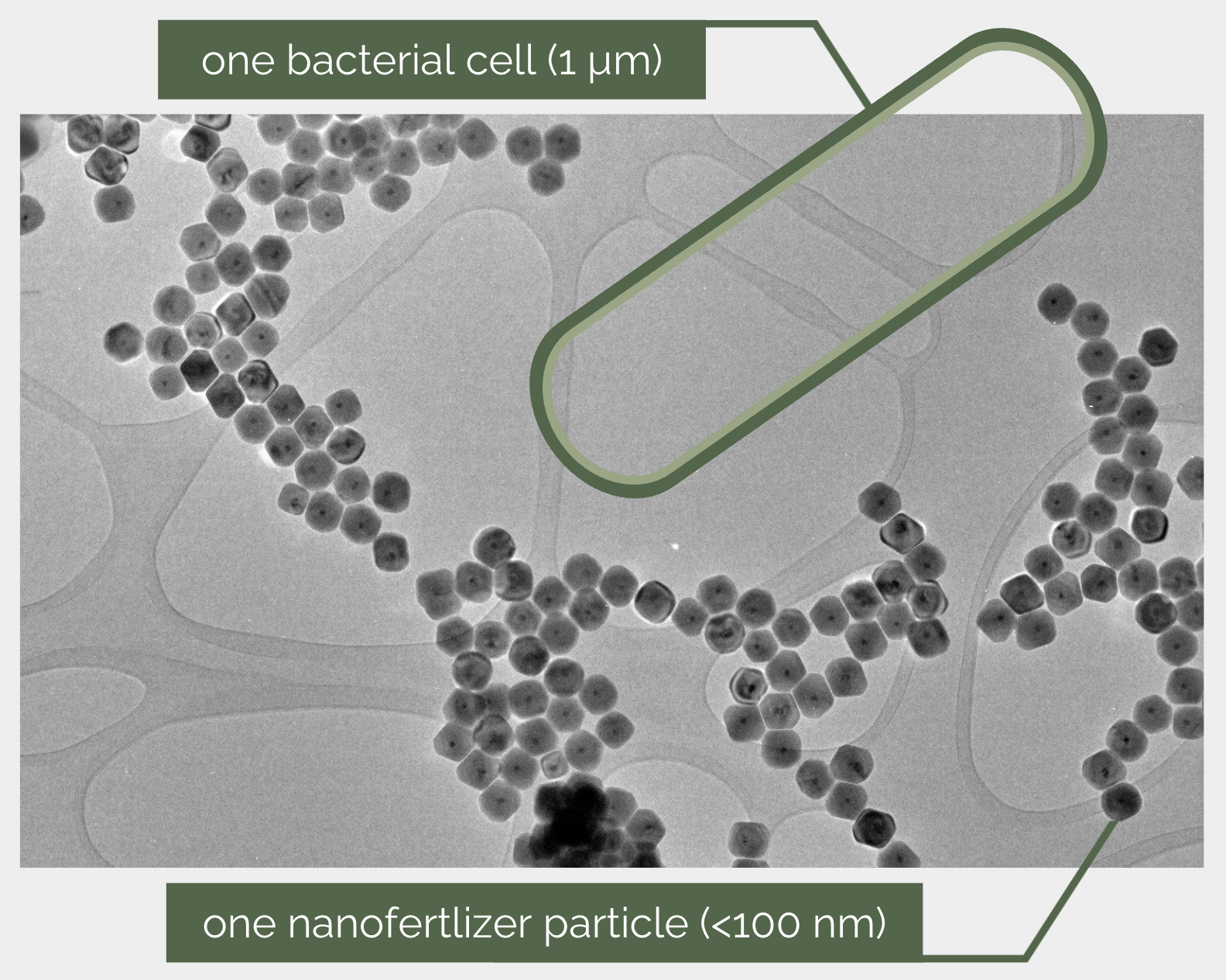
Visualizing the nanoscale at work
To convey how these tiny particles can move through plants, we submerged flower stems in a solution of gold nanoparticles.
At the nanoscale, gold particles interact with light in a unique way that produces a strong red coloration. If the particles dissolve or aggregate, this red color disappears.
The visible pink coloration in the petals shows where the particles have been transported to within the flower tissue. While simplified, this demonstration illustrates how nutrients can be delivered to crops—and translocate within them—at the nanoscale.

What does this mean for the field?
Nanofertilizer fertility allows nutrients to enter the crop in a more enduring form—providing sustained availability and benefits that extends beyond just treated tissue.
During 2025, we conducted a series of field trials across the U.S. on multiple crop types to evaluate formulation performance.
In one study, an iron-based micronutrient nanofertilizer was applied as a foliar spray on alfalfa.
Two months after application, the new-growth of treated plants still showed elevated iron and nitrogen concentrations, indicating improved nutrient uptake and prolonged availability through the formulation’s slow-release design.
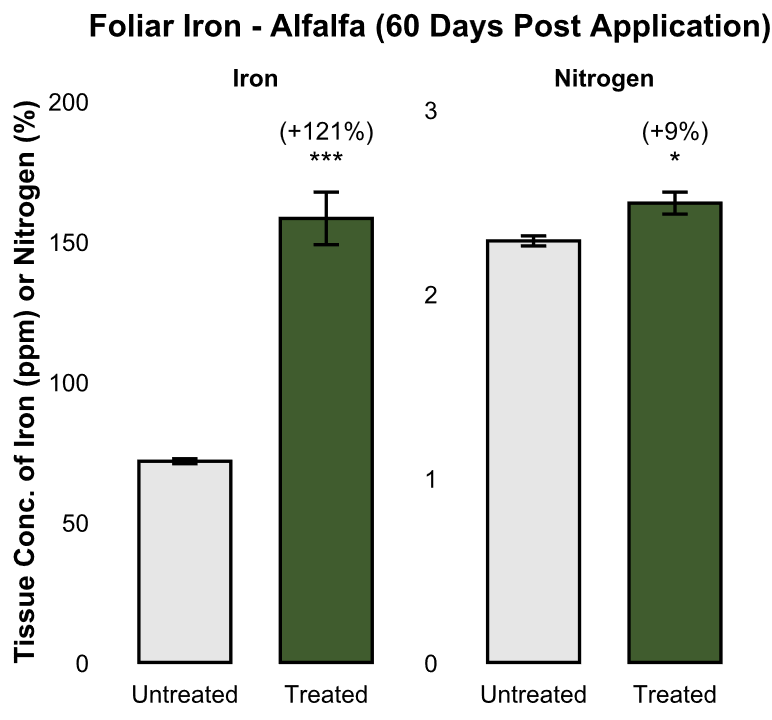
Performed in a controlled outdoor system under managed fertility and irrigation. Alfalfa seed was pre-inoculated. Foliar nanofertilizer applications were made with a handheld sprayer using pre-measured volumes. Tissue analysis was performed through Midwest Labs. Control (n=3), Treated (n=6). Each sample was a composite sample of the top 2-4” of new growth from approximately 125 plants. Tissues were washed with DI water after collection. p<0.001 = ***, p<0.05 = *